
How many clients does an independent assistant have? Through which channels does she find them? What difficulties does she really face? Until now, no one could answer with figures: the profession appears in no official statistics. Our 2026 national study, conducted among 57 working independent assistants across France, provides the first measured benchmarks on this profession.
If you already work in the field, you’ve surely asked yourself the question: am I within the norm, or off to the side? And if you’re preparing to launch, you’re navigating between glossy promises on Instagram and discouraging forums, never quite knowing where reality lies. It is precisely to fill this gap that we launched this survey.
In this article, you’ll find the study’s full methodology, four freely available findings, and the detailed table of contents of the summary document. If the profession appeals to you but you’re starting from scratch, begin with our guide how to become an independent assistant: it sets out the general framework that this study now puts numbers to.
Why a national study on the independent assistant profession
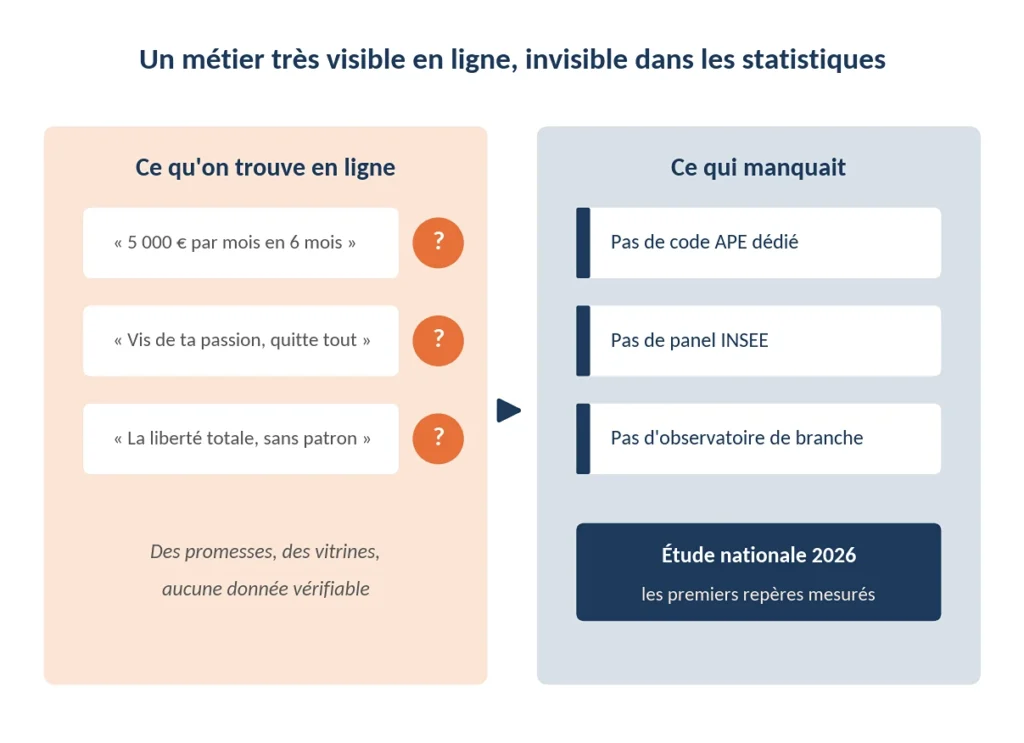
Because this profession is statistically invisible. There is no dedicated business activity code, no INSEE panel, no industry observatory: every woman who launches into it does so with no reliable benchmark, relying on isolated testimonials or on whatever social media chooses to show.
This invisibility comes at a real cost. How do you set a rate without knowing what the market is actually charging? How do you choose your prospecting channels without knowing which ones work for others? How do you normalize your difficulties when you don’t know whether others share them?
Since 2020, we have been training and supporting independent secretaries and assistants at Formassista. We had a feel for the field, passed on by our trainers who practice the profession every day. What we lacked was the data. In May 2026, we decided to produce it, and to share it.
How the study was conducted
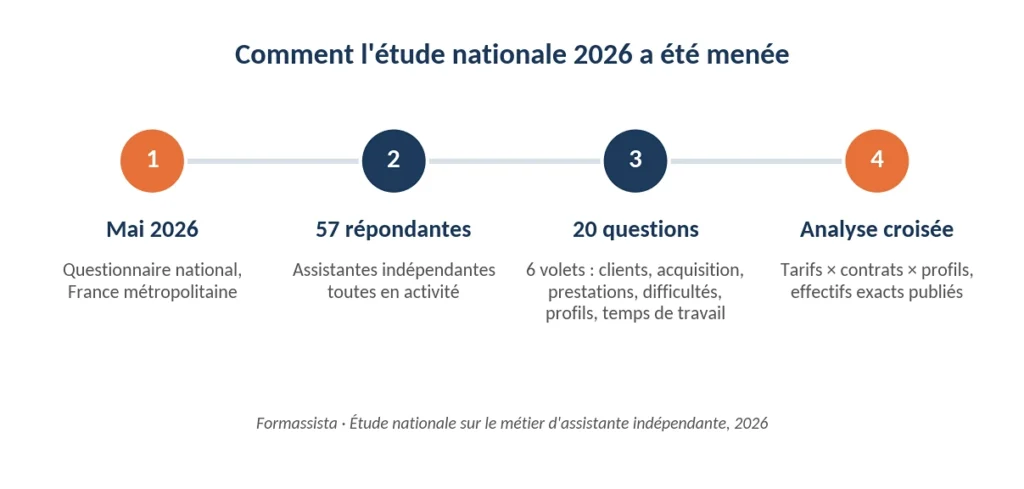
The survey was conducted in May 2026 among 57 independent assistants working in mainland France, all active at the time of the questionnaire. About twenty questions covered six areas: clients, acquisition channels, services and business models, difficulties encountered, profiles and career paths, and working hours.
We prefer to say it ourselves: 57 respondents is not a nationally representative survey in the sense of the major polling institutes. It is, however, the broadest snapshot ever published on this profession, gathered from women who actually practice it, rather than self-reported intentions. Every figure in the study is presented with its exact sample size, so you can judge for yourself.
The questionnaire did not stop at averages. Responses were cross-analyzed against one another: seniority, status, services, contract formats, rates. These cross-analyses are what deliver the most useful insights, and you’ll see below why we’re reserving them for the full document.
Four freely available findings
Here are four results from the study, published in full. They are enough to correct several misconceptions about the independent assistant profession.
A profession young in independence, mature in experience
67% of respondents have been working independently for less than 4 years. But 72% had at least 5 years of salaried experience as an assistant before launching out on their own. In other words, the move to independence isn’t a break: it builds on an already solid professional foundation, often after more than ten years in the profession.
This double figure changes the usual career-change narrative. Becoming an independent assistant isn’t starting from zero: it’s deploying a long-proven skill in a new setting. If you’re hesitating to launch out of fear of not being legitimate enough, this result is worth reading twice.
Nearly two-thirds started with no training
63% of respondents started with no specific training whatsoever: neither training in the profession itself, nor in starting a business. This is probably the most striking figure in the entire study. Nearly two-thirds of working independent assistants found their way by trial and error when they started out.
The study doesn’t claim this choice dooms a business — proof being that they are in business today. What it does document is what starting out with no benchmarks produces in terms of early-year trial and error, and the summary document devotes one of its three final strategic questions to exactly this.
Word of mouth outweighs every other channel
Word of mouth is both the leading real acquisition channel (52% of respondents find their clients through referrals) and the channel judged most effective (46%). No other channel comes close. Most surprising of all: social media, so prominent in the discourse, accounts for only 5% of actual acquisition. And a website combined with SEO collects zero responses for perceived effectiveness.
Spending hours wondering what to post on Instagram? These figures suggest looking elsewhere: a satisfied client’s recommendation carries more weight than months of posts. Our networking strategies build on this same logic.
| Channel | Share of real acquisition (Q4, 42 responses) | Channel rated most effective (Q5, 57 responses) |
|---|---|---|
| Word of mouth / referral | 52% | 46% |
| Professional network (clubs, BNI…) | 12% | 16% |
| Direct prospecting | 12% | 14% |
| Matchmaking platforms | 7% | 7% |
| Social media | 5% | 11% |
| Directories / listings | 5% | 4% |
| Website / SEO | 2% | 0% |
Source: Formassista, National study on the independent assistant profession, 2026.
Three difficulties that may in fact be just one
The top trio of difficulties is clear-cut: finding and retaining clients (63%), earning a regular and sufficient income (54%), gaining visibility (47%). Administrative tasks and rate-setting trail far behind.
Look closely at these three statements. Clients, income, visibility: what if they described a single problem seen from three angles? The study develops this cross-cutting reading, and it challenges the reflexive answer of “just prospect more.”
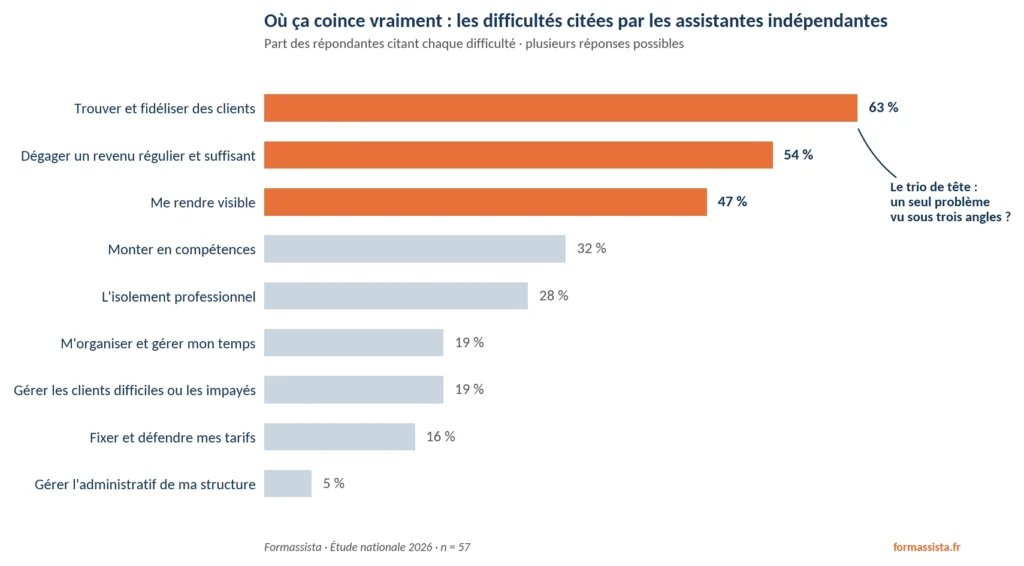
Chart: the 9 difficulties cited by independent assistants, top trio: finding clients 63%, income 54%, visibility 47%
The same study doesn’t read the same way depending on your situation. Three scenarios come up again and again among our readers.
Thinking about it, but haven’t decided yet? The study answers the question that comes before all others: is this profession viable, and for which profile? The profile and working-hours sections show who actually practices it, with what background and what day-to-day reality, far from the social media showcase.
Preparing to launch? The study gives you measured positioning benchmarks: which services sell, under which collaboration formats, within which rate range. Enough to build an offer based on data, not impressions. On the income side, our analysis of independent assistants’ income already details what the study reveals about the rates actually charged.
Already working in the field? The study acts as a mirror: compare your client portfolio, your channels, your difficulties against your peers. The cross-analyses in the full document show, above all, which choices set apart those who charge at the top of the range.
| Your situation | The question the study sheds light on | The section to read first |
|---|---|---|
| I’m thinking about it | Is the profession viable, and for which profile? | Profiles and working hours |
| I’m preparing to launch | How should I position myself: offer, format, rate? | Services and business models |
| I’m already working in the field | Where do I stand, and what tips the rate? | Cross-analyses and perspective |
What the summary document contains (and this article doesn’t say)
The summary document (14 pages) delivers the results in full: complete tables for all 20 questions with their sample sizes, cross-analyses, three cross-cutting readings of the profession, and three strategic questions to apply the study to your own situation.
Let’s be transparent about what we’re keeping for the document, and why. The figures published in this article describe the landscape. The cross-analyses in the document explain the gaps. Our article on independent assistants’ income gave a preview of this: contract format weighs more heavily on rates than diploma or seniority. The summary goes much further. It identifies a precise profile in which almost all charge €35 excl. tax/hour or more, with a 50-point gap versus the rest of the sample. It reveals the service with the most differentiating commercial potential (it is not the most commonly offered one), the service/contract-format combinations that concentrate high rates, and those that destroy them.
These are the results that turn a reading into decisions: which service to develop, which collaboration format to offer, which rate to defend.
| Document section | The question asked | What you’ll find there |
|---|---|---|
| 1. Clients | Who are they, how many are there? | Nature of the client base, share of revenue, portfolio size |
| 2. Acquisition | Through which channels do clients arrive? | Actual use vs. perceived effectiveness, channel by channel |
| 3. Services and business models | What do they sell and how? | Services, formats, rates, flat fees, and the cross-analyses that tip the rate |
| 4. Difficulties | Where does it really get stuck? | The 9 quantified difficulties and an overall reading of them |
| 5. Profiles | Who practices this profession? | Seniority, status, diploma, career path, age |
| 6. Working hours | How many hours to make a living from it? | Share of non-billable time |
| Perspective | What now? | Three cross-cutting readings, three strategic questions |
Where to get the 2026 national study
The summary document is available in our 2026 Study shop at the back-to-school price of €29. From September 20 onward, it will rise to €49. This deadline is not a marketing gimmick: it’s our launch price, dated and announced, so that the first readers are those who already follow us.
Why a paid document, anyway? Because an independent study has a cost: design, data collection, analysis, writing. The price of this document funds the renewal of the survey, with the ambition of an expanded panel with each edition. By purchasing it, you’re not paying for a PDF: you’re helping to give this profession the reference figures it lacks.
Get the study summary for €29 instead of €49 starting October 1, 2026
National study on independent assistants 2026
Download the summaryAre you a journalist, trainer, or blogger? Short quotations from the study are permitted with the credit “Formassista, National study on the independent assistant profession, 2026.” For any broader reproduction, contact us.
FAQ on the 2026 national study
Formassista, a Qualiopi-certified training organization dedicated to independent secretaries and assistants since 2020. The survey was conducted in May 2026 among 57 working assistants in mainland France.
82% of respondents charge between €25 and €44 excl. tax per hour. Final income depends on billable volume and expenses: our article on independent assistants’ income details the full calculation.
14 pages: the full results of all 20 questions, cross-analyses (rates, contracts, services, profiles), three cross-cutting readings of the profession, and three strategic questions. Price: €29 until September 20, €49 after.
Yes, short quotations are permitted with the credit “Formassista, National study on the independent assistant profession, 2026,” ideally accompanied by a link to this page.
Key takeaways
Well done for making it this far: you now know more about this profession than most online content will ever explain.
- The independent assistant profession has no official statistics: our 2026 national study (57 working respondents, May 2026) provides the first measured benchmarks.
- Independent assistants are young in independence (67% for less than 4 years) but experienced (72% with 5+ years as salaried assistants).
- 63% launched with no specific training at all, neither in the profession nor in starting a business.
- Word of mouth dominates acquisition (52% actual use, 46% perceived effectiveness); social media caps out at 5% of real acquisition.
- The cross-analyses that explain rate gaps are in the summary document: €29 until September 20, €49 after.
To go further: independent assistants’ income, how to become an independent assistant, and if inner hesitations are still holding you back, the 6 beliefs that look like caution but can hold back your project.
So, which of these figures surprises you the most? Tell us in the comments: your reactions will feed into the 2027 edition of the study.
The Formassista team
Qualiopi-certified training organization, dedicated to independent secretaries and assistants since 2020. Our trainers practice the profession themselves, every day.
Our team